Given the government has also set net zero carbon targets and that construction and buildings in use account for 25% of UK emissions, the building sector is concurrently having to shrink its carbon footprint.
To this end, the Future Homes Standard is expected to require higher levels of build quality, fabric efficiency and overall energy performance. Cutting construction waste is another environmental focus for builders, as is the carbon profile of individual building materials.
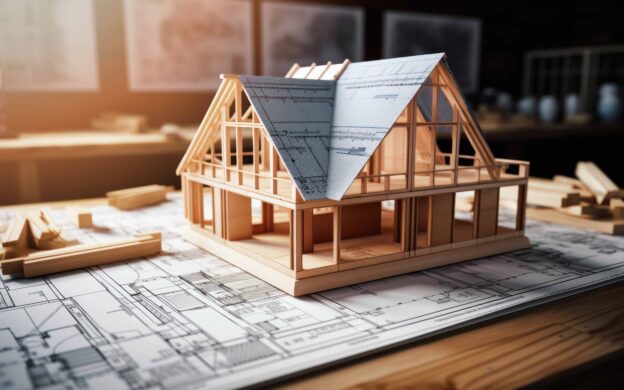
Against this backdrop, more timber-based building is clearly seen as a significant part of the way forward by policy makers and industry. It’s recognised as potentially up to 25% faster than traditional masonry construction. At the same time, timber is lower carbon to produce, process and transport than energy intensive building materials, notably steel and concrete.
Moreover, carbon sequestered by trees from the atmosphere while growing is locked into the timber building products for their lifetime. Its strength to weight also makes wood an ideal material for high efficiency, quality controlled offsite manufacture, where building assemblies are prefabricated in factories for rapid installation on site.
Roadmap urges innovation in timber frame
Consequently, government has set up the public-private sector Timber in Construction Working Group and tasked it with drawing up a roadmap for developing timber-based buildings in the UK. Government and industry, it concluded, need to work together ‘to promote use of safe, best practice, high performing timber construction that will provide the most benefit in supporting delivery of the net zero pathway, alongside other low carbon products and resource efficiency measures to build a low-waste, circular economy’.
Turning to the construction process, it highlights the need to boost timber building ‘capacity and competency across the supply chain’ and ‘to promote innovation and high performing timber frame systems’.
Weather resistant barrier installation challenges
A product that plays a critical role in timber frame performance, and application of which has implications for construction productivity, is the weather resistant barrier or WRB. Sometimes site fitted, although becoming more often offsite fixed, these are not just vital for protecting timber products and assemblies from the elements during construction. They prevent water ingress in the completed building, while most are vapour permeable too, allowing any intermittent internally generated moisture to escape the building envelope.
They can also play an important role in airtightness and hence energy efficiency and the Future Homes Standard sets an airtightness level of below 5m³/h.m² @ 50 Pa for new-build housing.
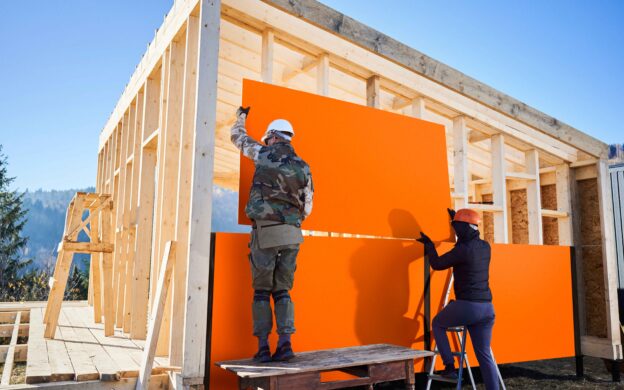
However, each of the main types of WRB in use, as we see below, have challenges when it comes to installation. Ensuring on site there are no gaps or joints for moisture to penetrate can take time and skill at a time of mounting construction labour and skills shortages. They can also be prone to damage during installation and/or transportation.
Weather conditions can impact or delay deployment and ensuring a correct fit around building details can be challenging.
Weather resistant barriers – Plastic membranes
Looking at the various WRBs used today, the most familiar is probably the site fixed polyethylene or polypropylene membrane. These are relatively cheap and combine water resistance with vapour permeability and can be fitted on- or off-site, fixed in place with plastic capped nails or staples.
They take expertise and experience to fit effectively. Membrane sheets must overlap accurately, they must consider complex details around doors and window frames, and joint tape effectiveness can be affected if running over the nails or staples.
They can tear and snag during installation or transportation, and adverse weather can make the job more difficult still. They also add a construction site process, potentially compromising timber frame building’s prized build speed. Moreover, inevitable off cuts add to site waste.
Weather resistant barrier – Building paper membranes
Building paper is a long-standing WRB. It is kraft paper impregnated with asphalt. It is heavier, so more of a job to handle on site, than plastic membranes. It can become even more cumbersome in poor weather. It is also less flexible and equally requires experience to fit effectively. It is mechanically fixed to the building shell and can rip during fitting, especially if wet.
Lower surface traction also makes it harder to fix to complex surfaces, and it can dry out and become brittle. Its performance is also not up to modern WRB standards. While giving good water resistance, it is not vapour permeable, potentially trapping moisture in the envelope resulting in mould or even rot.
Weather resistant barrier – Peel and stick solutions
Peel and stick, or self-adhered WRBs are a technical step up on plastic membranes and also more expensive, although producers say the cost is still a relatively small part of the build budget. Like other site fixed solutions they add a site process. Generally, an adhesive primer is first applied to the timber substrate. The backing of the WRB is then peeled off and it is adhered in place. Again, it’s a job requiring experience and an eye for detail to avoid gaps. Peel and stick products also adhere poorly to wet surfaces and if no primer is used, adhesion can deteriorate in cool weather. Also, adhesive primers should always be used with OSB given its uneven surface.
Further considerations include vapour permeability variation between products, so the right one for the job needs to be selected, and fluid applied flashings must be compatible with the particular make.
Weather resistant barrier – Fluid-applied WRBs demand experience
Fluid-applied WRBs are another step up in technology and price, but again producers say the latter is not a significant add-on to the build cost. They are claimed to deliver better water resistance and airtightness than plastic membranes and peel and stick WRBs and they’re vapour permeable. However, they also need skill to use effectively. They are brushed, rolled or sprayed on to the wood surface, with spraying said to be best for achieving correct wet thickness.
All approaches require experience and training. It takes about two days to apply the WRB coating to an average house and it’s a two-person job, with each performing a different role in spraying and sealing joints. It is also advised to use fluid-applied WRBs in warm weather, with the coating and hoses potentially requiring heating in cold conditions.
Thermally fused weather resistant barriers – the straightforward solution
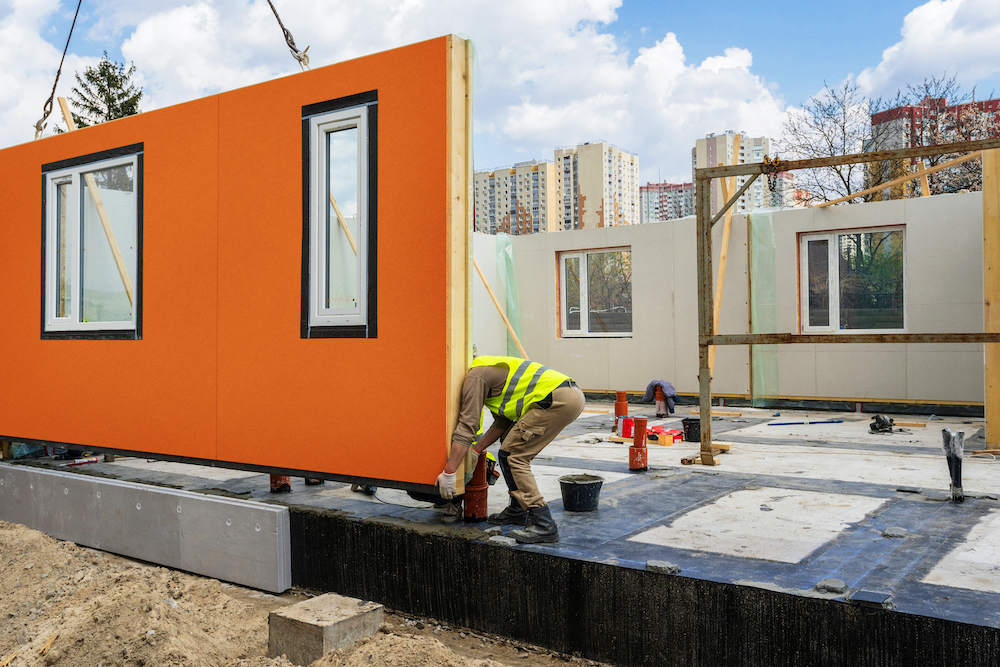
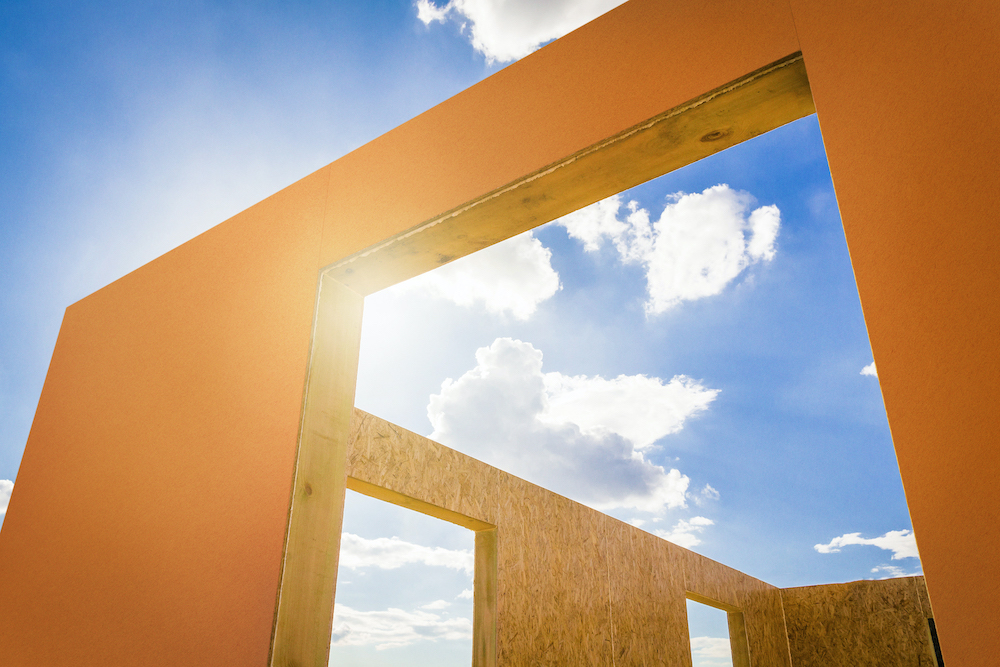

Arctek® Dryshell™ represents a different approach to WRB application. It’s the next generation technology and unlike most of its predecessors does not add a further site job in timber frame construction. It is a proprietary resin formula overlay and is an integrated solution, applied to wood-based panels not on site, but in the panel producer’s factory. Application in a quality and climate managed environment ensures consistent, uniform all-round coverage.
It means that the wood panel is ready protected when it gets to site. Arctek® Dryshell™ delivers high performance water resistance, it is vapour permeable, preventing build-up of interstitial condensation in the envelope, and it’s proven to improve air tightness, with joints between panels are simply taped on site, with zero waste to be disposed of.
Arctek® Dryshell™ effectively enhances the inherent quick-build benefits of timber frame and deskills the whole WRB application process, it’s automatically applied on the panel makers’ production line under heat and pressure. That is a key and growing advantage in today’s UK construction industry. There are currently 140,000 unfilled vacancies in the sector and it’s estimated that to satisfy housing demand it will need a further 250,000 people by 2028. In short, labour-saving technologies, like Arctek® Dryshell™, are set to become even more relevant.
Arctek® Dryshell™ – the straightforward solution
Arctek® Dryshell™ is relatively new to the UK and the rest of Europe, but it’s based on a technology that’s well-established, tried and tested across the US. It has proven particularly popular for use on OSB but can also be applied to other wood panel types. Besides delivering multiple benefits in site built timber frame, by removing the WRB stage in wall and roof assembly production, it also delivers productivity boosting benefits to offsite manufacture.
To find out more about how Arctek® Dryshell™ can support your future timber building projects, request a sample or enquire here.