Successive governments have agreed on 2050 as the target date by which the UK will transition to a net-zero carbon economy. While construction and buildings in use currently account for 25% of the country’s greenhouse gas emissions, the 2050 target can only be achieved if those emissions are cut. It’s increasingly recognised that using more timber in building projects is a principal route for achieving this.
Timber building’s carbon profile
Timber is lower in carbon to produce, transport, handle and process than energy intensive building material alternatives, notably steel and concrete. The TCR states that using timber rather than these other materials could cut the embodied carbon in a building by 20% to 50% – that is the CO2 generated in the manufacture, transport, maintenance and ultimate disposal of construction materials.
Moreover, trees sequester the main global warming gas CO2 from the atmosphere as they grow. The carbon is then stored in the timber building products for their lifetime. The TCR states that carbon storage in a timber frame home is around 50% more than in a masonry equivalent.
Wood’s natural energy performance
Timber is also a natural insulant, helping deliver energy efficient homes. Humans have known this for millennia. In fact, the earliest archeological evidence of a wooden structure dates back nearly 500,000 years. Now modern timber frame construction’s capacity to incorporate high levels of insulation builds on wood’s inherent properties.
Timber-based construction also generates less waste than buildings with other materials and what is produced lends itself to reuse and recycling. The TIR says this ties in with the UK’s ambition to be not just a zero carbon economy, but a more circular, zero waste one too.
Roadmap points to building better in timber
Drafted by the government-industry Timber in Construction Working Group, the TIR is not just about building with more timber. The focus is on building with timber better, faster and more efficiently. It’s set in the context of the government’s aim for construction to build 1.5 million new dwellings in its five-year term.
The TCR states that this ramping up of the timber building sector’s all round performance demands the combined efforts of industry and government. It needs research and development. It also demands innovation in supply chains, building approaches, strategies and products for timber construction.
Thermally fused overlay technology – the next generation weather resistant barrier
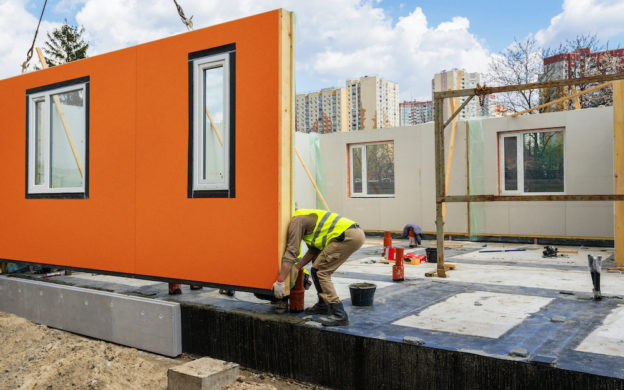

One such innovative product is the thermally fused integrated weather resistant barrier. Detailed more fully below, it is a pre-applied thermally fused overlay which provides all round protection for wood-based panels used in timber frame building. It is designed to enhance the performance and durability of the finished structure while simultaneously boosting construction productivity.
The TCR’s full list of recommendations add up to a truly holistic approach to taking UK timber building forward, from the forest to the construction site. To underpin the sector, it says the country needs to be more self-sufficient in wood. This means increasing forest cover from 12.5% now to 16.5% by 2050.
Timber-based offsite manufacture the way forward
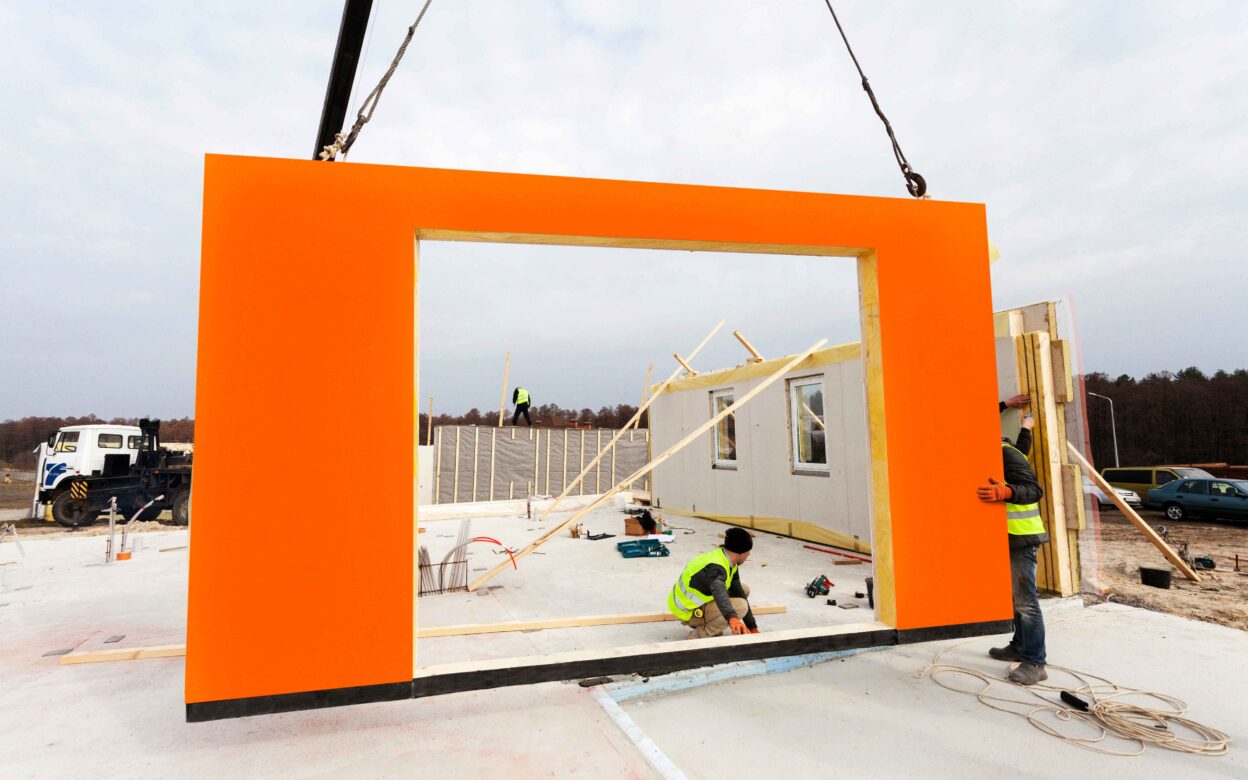
Due to its strength to weight and ease of handling and processing, timber is also recognised as an ideal material for offsite modern methods of construction. Here, building assemblies are prefabricated in climate controlled, quality managed factories. They are then delivered to site ready-made for rapid erection.
The approach cuts materials deliveries and consequently transport emissions and reduces site days. The result is overall a faster construction process. The TCR cites the example of a volumetric offsite timber frame system achieving a 50% faster build time than traditional construction methods. Hence, it says, more offsite house manufacturing is also needed.
Priorities for timber in construction
Besides opportunities, the TIR also addresses continuing obstacles to building more with wood and lays out ‘priority themes’ for overcoming them.
These include:
- Improving data on timber and whole life carbon
- Promoting the safe, sustainable use of timber as a construction material
- Increasing skills, capacity, and competency across the supply chain
- Addressing fire safety and durability concerns to safely expand use of engineered mass timber
- Promoting innovation and high performing timber construction systems
Promoting innovation for high performance timber building
Under the latter, the TCR says “We need to encourage innovation in building practices within the construction sector and promote methods and materials that have potential to increase efficiency and productivity”. As stated above, this is where the Arctek® Dryshell™ thermally fused integrated weather resistant barrier (WRB) comes in.
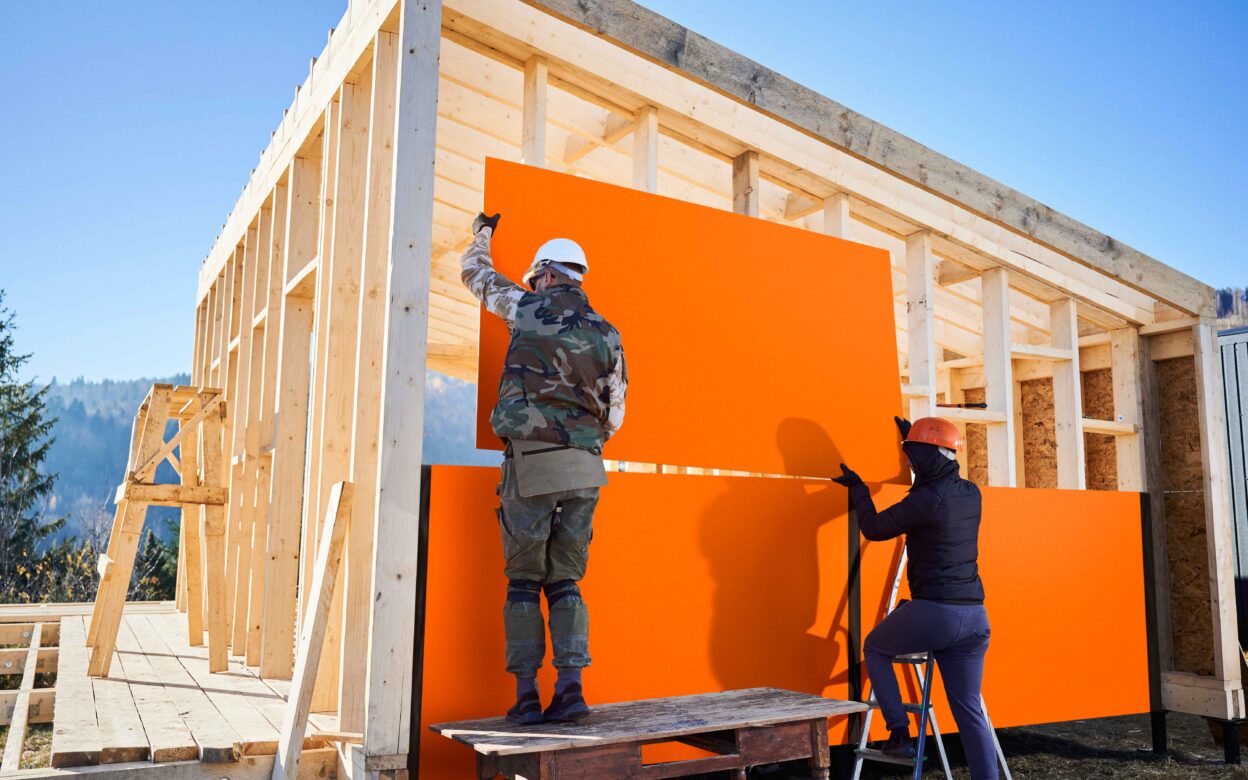
WRBs are a core element of timber frame construction. Encasing the building envelope, they protect materials from the elements during the build process. Most are not just water resistant but also vapour permeable. This allows any moisture build-up in the envelope to escape, preventing mould growth and potential rot. They also enhance building air tightness, boosting energy performance.
Conventional weather resistant barriers offset timber frame quick build benefits
There are a range of WRB types. Perhaps the most commonly seen in the UK is polyethylene or polypropylene house wrap. Then there is building paper, peel and stick and fluid applied WRBS. All these have their adherents, but they also have their drawbacks, which in various ways conflict with the aims of the TICR.
They are generally site fixed (but not always) or applied and require skill and experience. House wraps can snag and tear, as can building paper, potentially affecting their performance and structural durability. Both also require careful application to ensure the right degree of overlap.
Peel and stick and fluid applied products are billed as easier to deal with, but application can suffer in adverse weather conditions. Also, as with the other WRB types, they add another step, and therefore time to the construction process, potentially offsetting the quick build benefits of timber frame.
Factory barrier application ensures uniform protection
Thermally fused weather resistant barriers, by contrast, are applied by board manufacturers to wood-based panels – notably, but not exclusively OSB – in their factories. It is fused with the board under heat and pressure to achieve a consistent uniform layer of protection before the product is delivered to the building site. Pre-protected boards can also be delivered to offsite manufacturing plants for rapid, efficient incorporation into build assemblies.
Integration supports timber build productivity
Thermally fused weather resistant barriers therefore don’t add a further stage to the on-site build. They also deskill the WRB application process at a time of widely publicised serious skill and labour shortages in UK construction.
The overlay is based on a proprietary resin formula and also combines water resistance with vapour permeability, which allows moisture to escape, preventing interstitial condensation in the build envelope. It is also proven to boost envelope air tightness, with panel joints simply taped on site.
It is a relatively new technology in Europe but extensively used across the US.
Arctek® Dryshell™ helps meet roadmap requirements
Arctek® Dryshell™, a thermally fused weather resistant barrier, ticks the key TCR boxes. It is an innovative solution that can enhance timber frame construction durability and quality. Application is also an automated, ultra efficient process, helping drive timber frame productivity at a time, as the TCR stresses, when the focus of construction should be ramping up output of low-carbon wood-based homes.
To find out more about how Arctek® Dryshell™ can support your future timber building projects, request a sample or enquire here.